
Too Small for the Big Hall: Placing 249 TH/s With a Hosting Provider
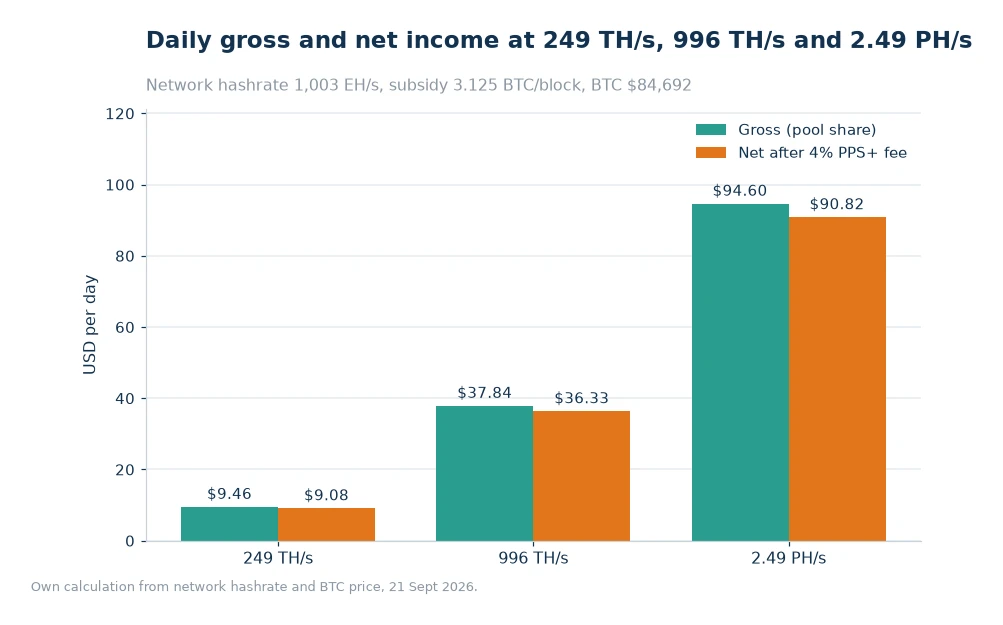
The first thing a small operator learns when shopping for a hosted slot is that size is a filter, not a detail. At 249 TH/s the daily credit is about 0.0001117 BTC, $9.46 gross and $9.08 after the listed 4% on the block-reward component. A provider built for 2.49 PH/s will take the meeting and may not take the machines.
Key takeaways
- 249 TH/s yields 0.0001117 BTC a day, or $9.46 gross and $9.08 net of the listed 4%.
- Providers sort by minimum block size, so ask for that number before discussing rate per kilowatt-hour.
- 996 TH/s is often the hardest size to place: above hobby scale, below the block sizes most halls quote.
- A directory shortens the search; the contract and the site visit still decide the outcome.
The minimum size problem
Hosting economics run on blocks of capacity. A hall with a fixed feed, a fixed cooling plant and a fixed number of hands does not earn much more from a hundred machines than from ninety, so the offer is usually structured around a minimum that makes the visit worth scheduling. That minimum is rarely published, and it is the first thing to ask about.
For a small operator this produces a strange market. The rate quoted per kilowatt-hour may be excellent and still irrelevant, because the entry ticket is a block of 500 machines. The useful question is not "what is your rate" but "what is the smallest block you will take, and what does that block cost in fixed fees". Those are different conversations.
Three sizes and what each one can ask for
The table sets out the three tiers used in this article with the daily output at each. The last column is the practical consequence: what a provider can reasonably be asked to include at that size.
| Tier | Hashrate | Net per day | Net per 30 days | Realistic ask |
|---|---|---|---|---|
| Single row | 249 TH/s | $9.08 | $272.40 | Space, power, basic monitoring |
| Half rack | 996 TH/s | $36.33 | $1,089.90 | Adds a named contact and repair labour |
| Container share | 2.49 PH/s | $90.82 | $2,724.60 | Adds SLA terms and a spare-parts pool |
The monthly column is the one that makes the negotiation legible. At $272.40 a month, a fixed fee of $150 leaves very little room; at $2,724.60 the same fee is a rounding item. That is why providers prefer larger clients, and why a small operator should look for one whose business is built around small blocks rather than trying to talk a large hall into an exception.
Why the middle tier is the awkward one
At 249 TH/s you are a hobbyist with ambition, and many providers have a product for that: a shared rack, a standard package, a published rate. At 2.49 PH/s you are a commercial client with a contract and a service level. At 996 TH/s you are neither. Too large for the packaged product, too small for the bespoke one, and often quoted a rate that assumes you will grow into it.
The way through is to arrive with a plan rather than a request. A provider who can see a path from 996 TH/s to 2.49 PH/s in twelve months will structure an offer around the destination. One who cannot will quote the small-block rate and wait for you to leave. Ask directly which of those two conversations you are having.
Worked example: sizing the monthly budget before the call
Bring a number to the first conversation and the rest of it gets shorter.
- Divide the daily 450 BTC across 1,003,000,000 terahashes: 0.00000044865 BTC for each.
- At 249 TH/s: 249 × 0.00000044865 = 0.00011171 BTC a day, carried as 0.0001117.
- Dollars: 0.0001117 × 84,692 = $9.46 gross.
- Net after the listed 4% on the block-reward part: 9.46 × 0.96 = $9.08.
- Thirty days: 9.08 × 30 = $272.40.
- At 2.49 PH/s, ten times the hashrate: $90.82 a day, or $2,724.60 a month.
- A hosting fee of $0.06 per kilowatt-hour on 249 TH/s at 20 J/TH works out to about 4.98 kW, or $7.17 a day, which is most of the $9.08 before any fixed charge.
That last line is the whole difficulty of small-scale hosting. Power at six cents already consumes about 79% of the net credit at this hashrate, so the margin has to come from somewhere other than a cheaper tariff. A provider quoting a rate well below the local norm is either subsidising the block or planning to recover it in a fixed fee.
What a directory can and cannot tell you
A listing tells you that a company exists, roughly where it operates and roughly what it offers. That is worth something, because it turns an unsearchable market into a shortlist of eight names. It does not tell you the minimum block, the actual tariff with cooling included, the repair policy, or how the site behaved during the last heat wave.
Treat the ViaBTC Mining Companies directory as the start of a process rather than the end of one, and use the Mining Farms page for the categories of arrangement rather than for a price. Between the two you can name what you want before anyone quotes you for something else. Neither substitutes for a call, and a shortlist of three is more useful than a longlist of ten, because the questions are the same each time and the differences only show up in the answers.
Questions worth asking before a site visit
Five questions, in this order. What is the smallest block you will host, in machines or in terahashes? What is the all-in rate per kilowatt-hour including cooling and any network charge? What uptime do you report, and against which measurement? Who supplies and pays for spare parts, and what is the target turnaround? What notice do I need to give, and does my hardware leave with me?
If the answers arrive as a brochure, ask again in a sentence each. A provider who can answer briefly has usually answered before, which is the only proxy for experience you have at this stage. Bring the answers back to your own arithmetic the same day, while the numbers are still fresh, and note where a provider's figure would have to be true for the offer to work.
Frequently asked questions
Is 249 TH/s too small to host?
Not inherently, but the field of providers is narrower. At $272.40 of net credit a month at $84,692, a fixed fee of $150 consumes more than half the margin, so look for providers who publish a small-block product rather than negotiating an exception.
What does Miner Hosting include at this scale?
Usually space, power, cooling and basic monitoring, with repairs charged separately. Whether spare parts and labour are included is the single most useful line to clarify, because a failed board at 249 TH/s can cost more than a week of credit.
Should I grow to 996 TH/s before approaching a provider?
Only if the extra machines are already funded. Arriving at 996 TH/s with a credible plan for 2.49 PH/s is stronger than arriving at 249 TH/s with a promise, but paying for hardware early to improve a quote is a poor trade.
Bring the number, not the hope
Write your hashrate, your monthly net at current conditions and the highest all-in rate your margin can absorb. Then call three providers and ask only the five questions. The one whose answers fit your number without a rewrite is the one to visit, and the visit will confirm what the arithmetic already suggested. A Profit Calculator run before the first call keeps the monthly net from drifting as the price moves.
Sources: ViaBTC companies, farms and pricing pages. Chain readings on 21 Sept 2026: 1,003 EH/s across the network, difficulty 132.76 T, 3.125 BTC per block, BTC at $84,692. Power arithmetic assumes 20 J/TH and a six-cent tariff. Published 24 Oct 2026[1].