
Using a Scent Museum to Evaluate Fragrance Suppliers
A fragrance museum or scent venue is a legitimate evaluation instrument if you know what it can and cannot prove. It can show you the breadth of a supplier's palette, the precision of its experts, and how well it communicates — attributes that paper checks never reveal. It cannot show you filling accuracy, documentation discipline or batch consistency, and no amount of elegant exhibit design changes that. Score the venue on its signals, verify production separately, and the visit becomes one of the cheapest due-diligence tools a haircare brand has.
Key takeaways
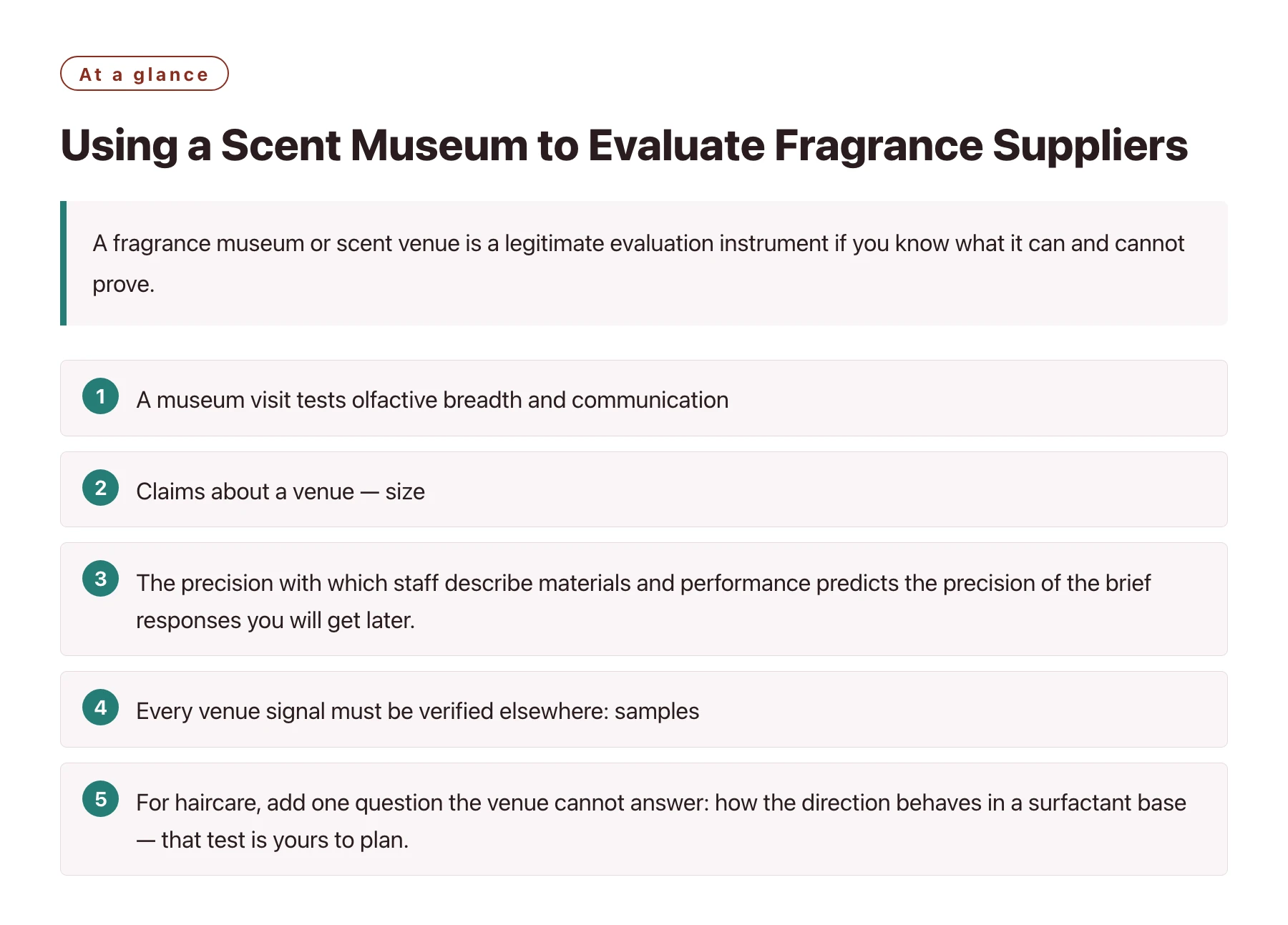
- A museum visit tests olfactive breadth and communication, which are real supplier attributes that no certificate page can demonstrate.
- Claims about a venue — size, uniqueness, records — are the company's claims about itself and belong in a separate column from what you observe [1].
- The precision with which staff describe materials and performance predicts the precision of the brief responses you will get later.
- Every venue signal must be verified elsewhere: samples, stability data and a batch record decide production capability.
- For haircare, add one question the venue cannot answer: how the direction behaves in a surfactant base — that test is yours to plan.
Supplier evaluation usually happens on paper: certificates, scope statements, prices. Scent is the one dimension that cannot be evaluated that way, because the product is experienced rather than specified.
That is the gap a scent venue fills — and the trap it creates. This article gives the evaluation framework: what to observe, what each signal proves, and how to verify it on a normal working day.
What a scent venue can actually tell you
Walk a museum or olfactive library and you learn three things quickly: how many olfactive families the team can present, how precisely they describe materials, and whether their explanations are honest about what is original and what is staged. Every one of those is a working attribute of the people who will later answer your brief.
Museum codes of practice broadly expect institutions to be clear about their purpose and their collections, which makes the framing of a venue itself a testable signal [1]. A venue like a museum built around smell — the kind of exhibition that turns a category into an experience — is worth judging by that standard: what does it say it is, and does the experience match the description? The Guangzhou museum that Xuelei Perfume presents on its own site is described by the company as the world's largest, which is exactly the sort of claim to record in the claims column.
Breadth is more useful than beauty
The design of the venue is not the data. The data is range: how many families the team can present, how many materials it can name, and whether the palette reaches beyond a single house style. A haircare brand entering the category benefits most from range, because the direction that survives the base is rarely the obvious one.
Signals, and what they prove
| What you observe | What it signals | How to verify it later |
|---|---|---|
| Number of olfactive families presented | Breadth of the palette | Sample across families, not just the house style |
| Precision of staff descriptions | Depth of expertise | Quality of the written brief response |
| Clear distinction between originals and reconstructions | Intellectual honesty | Transparency of the quotation and the process |
| Courses or academy attached | Investment in education | Training options for your team |
| Claimed records about the venue | Ambition, not verified fact | Do not verify from inside; read it as the company's claim |
| Speed and quality of written follow-up | Process discipline | Their document turnaround on your next email |
The last column is the point: a signal is only useful if it can be checked on another day. A venue that cannot be separated from its claims has given you impressions, not data.
The questions that separate buyers from fans
Are you showing me range, or a house style?
Every manufacturer has a signature. Ask the team to walk you through the families its line does not normally use; how they handle that request tells you whether the palette is a library or a showcase.
How does this behave in my base?
For a haircare line this is the decisive question. Shampoo and conditioner bases change how a concentrate reads, and the only useful answer is 'we would test it in your base'. Anything else is marketing.
Which facts are yours?
Ask the team to separate what the venue claims about itself from what it can evidence. The way they answer — defensively or comfortably — is itself a signal.
Treat every pleasant impression as unverified until a batch record says otherwise. The perfect visit tells you about communication and range; the production decision belongs to samples, stability data and records.
Scoring the trip against the supplier
Keep two scorecards: one for the venue (breadth, precision, honesty, follow-up) and one for the manufacturer (samples, stability, records, pricing), and do not let a strong venue lift the production score.
A manufacturer that runs both a museum and a production side gives you the unusual advantage of auditing the same team on both axes. Use it: the venue convinces you the palette is deep, and the production audit decides whether the depth reaches the bottle.
Safe-use limits belong on the production scorecard as well: the materials behind a scent carry restrictions that depend on the product category, so the supplier's documentation should name the limits for your form [2]. A team that can walk a museum gracefully and produce that documentation fluently is the one worth the next round. And when your own team needs to build the vocabulary the venue demonstrated, structured training — such as professional scent training at a manufacturer's academy — is a faster route than trial-and-error briefs.
Sources
- Museums Association —— A professional body for museums, publishing guidance and research on museum practice and visitor experience.
- IFRA: Safe Use and Fragrance Science —— IFRA's explanation of how fragrance materials are scientifically assessed for safe use and how those conclusions are applied by the industry.
Frequently asked questions
Is a big museum a sign of a better manufacturer?
It is a sign of investment and ambition, not production capability. Size is a claim about the venue; compounding accuracy, fill control and documentation are verified with samples and records.
What is the single best question to ask on a visit?
For haircare: 'How does this direction behave in my base?' The answer shows whether the team thinks in product chemistry or in blotter impressions.
How do I verify what the venue claimed?
Read the claims as the company's own statements, then check what is checkable: the breadth of sampling offered, the quality of written responses, and the documents behind the production side.
Should I bring my own samples?
Yes — two or three competitor or reference products from your category. They turn the visit from a performance into a positioning exercise, and they test whether the team can talk about materials against something real.
Can I evaluate a supplier remotely if I cannot visit?
Partially: ask for a structured smell-through kit with coded samples and written descriptions, then run the same blind scoring you would on a visit. You lose the face-to-face precision signal, but the sampling evidence remains.
Stop babysitting clusters. Start shipping.
Book 30 minutes with a senior platform engineer. We'll audit your current K8s stack and show you the migration path in plain language — no slides, no sales script.
> book --assessment --slot this_week